The Rivers that Rose: Third Lifetime
Total Eclipse → Solar Return
The Rivers that Rose:Third Lifetime
(3/3)
March 23, 2025
“So… the third lifetime?”
That one made sense immediately.
“Whenever you're ready…”
The guide grabbed his pen and notepad.
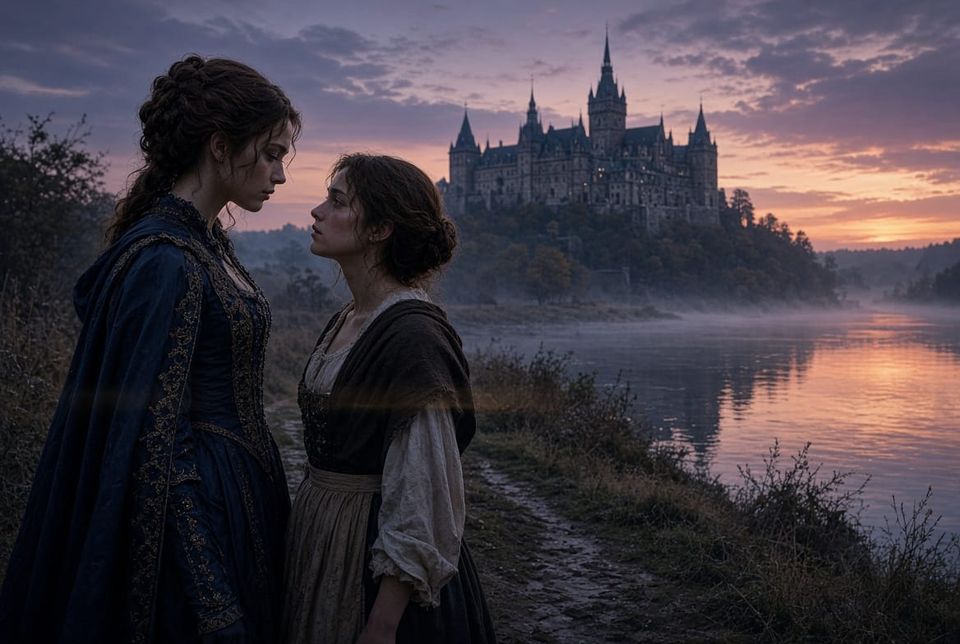
“It was about missing out on love. But not just any love. The forbidden kind of love… The past life reader told me I was a woman in that lifetime, and that I was like part of the house staff. Like a maid, or something close to it. Lower status. Working in a castle. There was a prince and a princess, and all these people around them carried the same essence of the kingdom. Bougie. Judgy. Very committed to hierarchy.”
Ari made a face.
“Not sure how I got entangled in all that, honestly.”
“Go on.”
“She said the princess and I spent a lot of time together. Something about the prince always working, and how we got close enough to fall for each other.”
“The thing is, she said this took place a long time ago… A time when two women couldn't be anything more than sisters or friends. She said the princess and I were in an impossible situation, and for more than one reason. I mean, even if that lifetime had been between a man servant and a woman princess, the social status divide would have got 'em condemned.”
The guide nodded.
“Anyway, the princess was seen as noble. Honorable. The treasure of the kingdom. Whereas I was seen as the opposite. Dishonorable. Trash. Someone who would tarnish the image this princess had spent her whole life cultivating. Which, rude, but apparently consistent with this lifetime as well.”
“In what way?”
“Ya know, being at the bottom of the barrel. I know that feeling all too well.”
Ari knew this silence meant he was supposed to continue… so he did.
“The helper in the house. Serve, clean, carry, anticipate, fold the laundry, step away. Useful enough to be tolerated. Invisible enough to survive. That role was not foreign to me. It felt like home in the most irritating way.”
“Why was that?”
“Well, you see, growing up I was often referred to as a ‘slave.’ Like, that's literally what Mother would call me… a ‘black slave,’ specifically… and I often would show up, set the table, and then walk away and go back to some random corner in the house while my family ate dinner together.”
“That's awful, Ari. I mean, my God, to be called a slave and to be treated like that! Why do you think that was?”
“In a word? Colorism. In a nutshell, I was basically the darkest in the family, and that puts you low on the hierarchy. Mother didn't want to be seen with me, so I often was alienated from the rest of the family, like I had leprosy or something.”
“Ari, I grew up at a time when kids were meant to be seen, not heard. But you, it seems you weren't allowed to be neither seen nor heard.”
“I mean, it wasn't like that every day. You know, my parents really cared about how they looked to others, so when people would come around, like if we had guests over at our house, they'd ask about me, and that's when I'd come out and get to play pretend until they left and we went back to normal again.”
“Play pretend?”
“Yeah, as if I'm always treated like everyone else.”
“Everyone else?”
“My siblings. My brothers and sister.”
“Oh, I see. You have siblings… And what about them? Would they say anything about you being treated like this?”
“There were definitely times as they got older where they would say something about it… But not as much when we were younger. I mean, it's all they ever really knew as well… So I think we all just kind of treated it like normal.”
“And your father?”
“He was never really around, because he worked a lot. But whenever he was around, he'd usually be drunk, and he thought he would be defending me, but that often just looked like him making things worse.”
“Worse, how?”
“You know, taking it out on my mother… which then would lead to us getting involved, and then him taking it out on us. Shit like that.”
“My God, Ari… I'm sorry.”
“Yeah, but you know, both my parents worked a lot, and honestly, I spent a lot of time alone… I enjoyed my own company. If anything, I actually hated having people around, because I knew that the only reason they would call on me was if they needed something.”
“What would you do with all that time alone?”
“A lot of things. Usually reading and writing.”
“Like what?”
“Hah, I'm embarrassed to say. I was a fucking nerd, man. I read shit like the dictionary, because it was the only book laying around in that corner of the house, and I wrote poems and shit like that.”
Ari laughed it off.
“We don't have to get into all that. So, as I was sayi—”
“—Ari, I won't push it. I just want to say, before you go on, I'm really sorry you had to go through that.”
Ari nodded, slightly quivering, while looking down at the table. The guide redirected Ari back to the final lifetime his past life reader had told him about.
“Okay, you were saying it was an impossible situation because of the fact that you were both women in that lifetime, and how even if you weren't, it would have still been punishable because of the social status…”
“Yes… and yet…”
A moment of silence.
“And yet?”
Ari looked up with a sad expression and half a smile.
“And yet we loved each other.”
The room seemed to quiet around that.
“Hm.”
The guide nodded respectfully and looked down. Ari laughed out loud. The guide looked up.
“I remember when the reader told me that they fell for each other, and I joked that I was basically a peasant going for a sugah momma. And she got serious and said that we actually had a lot in common, and really got to know each other, and were there for each other. She said the ache and longing became unbearable. I literally laughed out loud when she said that.”
“What was so funny?”
“Well, I grew up with my cousins at one point, and one of them is a lesbian, and I always caught her watching those old-time lesbian movies where every glance across a candlelit hallway carried the emotional weight of a war crime.”
They both laughed.
“I joked again and asked my reader if it was like that, and she got all serious and said no. It wasn't as cliché, because it didn't have the kind of ending those movies tend to have.”
Ari shrugged his shoulders.
“I honestly have no idea how those movies end, so I asked her what she meant by that… but she redirected back to my lifetime and got us back on track. She said what actually drew me to the princess was that it was only in her presence that I felt like an equal.”
“What do you make of that?”
“I mean, it makes sense. Everyone probably treated me as though I was beneath them. And well, you and I already covered that…”
The guide nodded with a sad expression. Ari continued.
“But I also know what it's like to have someone show up and see you in ways no one ever has… you know, in a way that kinda makes you feel better about yourself than you've ever felt before knowing a person like that.”
“You seem to really connect with this lifetime in more ways than one, Ari.”
“Yeah, it seems so! Which is why I connected with it instantly and wanted so badly to tell you about it earlier!”
They both laughed. The guide resumed.
“So it sounds like in that lifetime you both talked. You got to really know each other. Seems you spent time together while you worked. In the house, outside, fields or gardens, places where being near each other could still be explained to others around?”
“Yeah, exactly. Just like that.”
“Did anyone notice?”
“She said we were always careful. I think everyone could feel it before either of us said anything. The prince was often gone. Busy. Absent. Probably the last person to understand what everyone else had already sensed. But like she said, the ache became unbearable. Got to a point where we couldn't—or maybe just didn't want to—hide it anymore… ya know, the love we had for each other.”
“So then what happened?”
“So we made a plan. We were going to leave. Elope, I guess, although that word feels too cute for what it must have been. We were going to leave the structure. Meet at the river. Then cross it together. Sail away into the sunset. Then live as commoners. Choose each other. You know, that hopeless romantic shit.”
“And then?”
“I showed up.”
His voice got quieter.
“She didn't.”
“How come?”
“Because they wouldn't let her through…”
The guide gave Ari a puzzled look. Ari clarified.
“Someone else came instead.”
“Who?”
“A man. A guard, maybe. Someone sent with a message.”
“What message?”
“That she wanted to come. But they wouldn't let her through.”
Ari repeated it.
They wouldn't let her through…
The sentence stayed in the room longer than he wanted it to.
“What does that mean to you?”
“Well, it clearly meant something, because it became a lyric.”
“A lyric?”
“Yeah…”
“Like a verse to one of your poems?”
“Yeah… That was what I called them when I was a kid, but now that I found a way to make music out of it, I call them songs. And I recently wrote a song about that.”
“I see. And that line became a lyric?”
“Yes.”
They wouldn't let her through…
Ari nodded.
“What made you even want to write a song about it?”
“Well, shortly after the reading, I just felt so deeply connected to that lifetime, because I felt like a part of me already lived it… And I think in real time I was going through something that was already bringing the past back up in ways that left me in my feelings. And I guess that's what happens when I get too much in my feelings. I will write about it.”
“I see.”
“Yeah. In fact, it's on Spotify.”
“Sorry, spot on?”
“Oh, no, uh. Spotify. Like a major streaming platform. Ya know what, never mind. It's on YouTube, which is like a video website…”
“I know what YouTube is, Ari…”
“Oh, okay. Sorry.”
They both laughed.
“What's the name of the song? I'll write it down.”
“Or I can just send it to you. It's called, uh… damn.”
Ari drew a blank.
“I haven't actually listened to it since I finished publishing it. I honestly forgot what it's called. Something about a river.”
“A river?”
“Yeah, because when she described this lifetime to me, this image of the river stuck with me. Because that was their meeting point.”
“The river seems like a strong theme running through each of the lifetimes you shared with me today, Ari.”
“Yeah, I see that too. Not sure what to make of it… do you?”
“Well, rivers are made up of water, and water reflects emotions. And you mentioned that you write whenever you are deep in your feelings. Not to mention your past lifetimes also consisted of a river that served like a great divide between you and another way of life. Or soul…”
“I like the way you put it like that. At least this lifetime wasn't nearly as tragic as the last one.”
“Do you think so?”
“Well, yeah. I mean, losing a child is not the same as losing the love of your life.”
“For some people, that's two sides of the same coin.”
“I'm sorry you had to go through both, Mr. St—”
“Thank you, Ari.”
“So then, I assume you were able to move on?”
“What's that?”
“You mentioned one being more tragic than the other. So is it fair to say in that lifetime you were able to end up with the princess after all? Or perhaps meet another woman and live happily ever after?”
“Actually, no. That's the thing. She said I couldn't do that. She said the next day I was fired, and it turns out the royal family, or whatever, knew all along. Kind of like don't-ask-don't-tell bullshit. They didn't care that the princess was suffering and longing to be with someone else. All they cared about was how it made them appear to everyone else…”
“As for me, I could never go back to that castle. I was not welcome, and I also refused to move on. The reader told me I was very young, very attractive, and despite being a commoner, I had a lot of suitors. Men in very high places. But, obviously, they weren't my type. I asked about any other women. She said that I wasn't willing to give other women a chance to love me, or let me love them. Not even in secret. Told everyone my heart had already been taken. Told them I was waiting. Turns out I waited forever. I lived to be a very old lady who still carried the princess deep within me, with nothing to show for it. No one by my side. Died a lonely death.”
“It's interesting, isn't it?”
“What's that?”
“How even though you believe the lifetime in which you lost your child and the one in which you lost your lover are two different things, somehow the end result remains the same.”
“What are you talking about? They are completely different. I was locked up, called insane, in one of those lifetimes. And in the other one, I just chose not to be with anyone ever again.”
“Ari, sometimes we don't have to actually be in a restricted area to feel imprisoned. Sometimes the mental prison within our own mind is enough to keep us trapped within the same set of circumstances that continue to reinforce the pain we are in.”
“I mean, in that lifetime, in which I never got to reunite with my lover… was I really in pain? Because it sounds to me like I was single and free as can be. I don't know, maybe I'm just projecting. I mean, that's how it feels to be me… But if anything, that princess sounds like she was in prison. Because even though they called it a palace or a castle or whatever, she still had to wake up next to somebody she didn't even care to be with anymore, while the love of her life got to roam about the world free as a bird, getting all these suitors and people lovin' on her.”
Ari laughed.
“Now that sounds like a tragic ending. But not for me.”
“Tell me something, Ari.”
“Sure.”
“What made you write a song?”
“What?”
“The song about the river. What made you even write a song about it?”
Ari got uncomfortable and leaned back in his chair.
“I don't even know if we need to be talking about this.”
“It's interesting, isn't it? You have no problem opening up about the most tragic, deepest, darkest moments of your life. Yet I'm asking you about a lifetime in which two lovers couldn't end up together, and now all of a sudden it's no longer relevant?”
“I know I'm pissing you off. But I think I have the leverage to continue to guide you in a way that challenges you. So I'm asking you to tell me anyway. What made you write a song about this, if this lifetime wasn't so tragic after all? At least not for you. Why, then, were you the one with the pen behind it?”
Ari sighed.
“That's not true. I wrote about the other lifetimes too! I know it's weird, but I just kept having intrusive thoughts, or memories, or dreams, or whatever, about those lifetimes after the reading. I thought she implanted those memories in my head or something, so I figured the only way out would be to write about them. So I wrote about them. I don't see the big deal. I don't even remember the names of them, but I could prove to you that I wrote songs about the other two lifetimes as well. I just never published them.”
“Well, that spot on, Ari.”
“What?”
“The major stream you mentioned.”
“Oh, you mean Spotify. Haha, yeah. What about it?”
“You said you published them.”
“No, not all of them. Just one of them.”
Ari became uncomfortable.
“Oh, I see. So you published only one of them, and it was the one about the river. But they are all about the river… Do you remember which one?”
Ari did not want to admit it, but he could no longer fight the realization that this lifetime did in fact stand out to him in more ways than one. Because even though he wrote about the other lifetimes, this was the only one he published. The only one he gave a title to. The only one he gave an image to. The only one he gave the major streaming platforms access to.
“Um… It was about this particular lifetime, sir.”
“This one? In which they wouldn't let her through…?”
Ari nodded.
“I see. That's honest of you, Ari. So I won't ask again. But I trust you understand the significance behind my question.”
Ari nodded.
“Yes, Mr. St— I know I said I have a lot to learn from you, so I trust there's a reason you're asking this question. But I don't know what this is going to open up, and it's already late. I'm not sure we'll ever get to the rest of it.”
“The rest of what? It sounds to me like you already told the beginning, middle, and end.”
“Oh shit, I did. I don't know. I guess it just felt like there was a lot more to it.”
“Maybe because there is…”
“Go ahead.”
“Alright. Um…”
“We are closing up for the night. Take care, everyone. Goodnight.”
“Looks like it's time to go.”
Ari laughed.
“I am the timeline.”
Ari looked confused.
“I appreciate that you want to hear the rest, but I thought we were just supposed to talk about lifetimes. And besides, I have clients tomorrow. I should probably head out in a bit.”
“Ari, we are here to talk about lifetimes. And right now you were just about to explain to me why you wrote an entire song about this particular lifetime… And we will get out of here a lot sooner the quicker you begin, and the smoother you answer my questions, without friction or resistance.”
“You said you trust the reason I'm asking. So then trust it, and go ahead and get started.”
“Okay, then.”
“I wrote this song because…”
“Because it already felt like something I lived.”
No answer came. He knew he was supposed to keep going.
“I met someone.”
The room let the sentence stay simple.
To Be Continued
Published 10/13/26
“I met someone.”
“Tell me about her.”
“Well, we were young. I had just gotten out of my first relationship, which, looking back, felt like an arranged marriage that almost happened because our families wanted it more than we did. There was no chemistry. No romance. And I’m a hopeless romantic, so you can imagine how well that was going to work out. I learned that I couldn’t choose someone with only my head and expect my heart to follow.
“Luckily, that ended. And shortly afterward, I met her. My River of No Return...
“She had her own complicated history with family expectations, duty, engagements, all of it. We were both involved in this organization at the time. I had been elected president, and she was elected vice president. That summer, we started meeting regularly to prepare for the upcoming year, and we connected almost instantly.
“It was the kind of soul recognition you read about in mythology. Venus and Mars, that sort of thing. I remember feeling like I’d known her forever. Like maybe we’d been best friends, or even siblings, in another lifetime. I know how that sounds. But that’s genuinely how it felt at first.”
“At first?”
“Yeah, because then the school year started, and everything got weird. The former president, whom I’d beaten in the election, ended up befriending her. And suddenly, the person I’d spent the entire summer connecting with was practically on the opposite side of the room. There was this whole executive board conflict. People were trying to push me out of my position, and somehow, she remained connected to the very people trying to remove me.
“I couldn’t understand it. One minute, we were best buddies. The next, it felt like we were enemies.”
“What do you make of that now?”
“Oh, God. I could probably write an entire dissertation on those group dynamics now. Triangulation, scapegoating, gaslighting, the whole fucking circus. It’s fascinating how quickly a group can agree that one person is the problem when nobody wants to examine the system they’re participating in. But I didn’t have that language back then. All I knew was that several women had suddenly turned cold toward me, and ironically, the men were the ones standing beside me. Which was heartbreaking in its own way.”
“And what happened between the two of you?”
“Somehow, we found our way back to each other after all the drama fizzled out. I couldn’t tell you exactly when it happened. I just know that once we reconnected, whatever was between us became impossible to ignore. It was out of this world.”
Ari laughed at himself.
“Ugh, that sounds so fucking cringe. But I’ve genuinely never had a good category for what we were. Friends. Best friends. Whatever language made the relationship socially acceptable for this beautiful South Asian, Indian-Hindu woman. We expressed our love for each other constantly, and somehow we were still standing at the edge of something neither of us seemed able to name.
“I’d been in a relationship before her. I thought I understood intimacy. Then I met this person and discovered an emotional closeness, this sense of familiarity, that I hadn’t even known I was missing.
“She graduated early and went on to manage several of her family’s companies. You know how some people take a sabbatical right after college, before they spend the rest of their lives working? Well, this woman was unlike anyone else I’d ever met. She basically inherited an entire set of super-adult responsibilities before most people had figured out how to do their own taxes.
“She managed hotels, cafés, gas stations. And she carried those responsibilities like they were hers to carry. Maybe, on some level, because they were. I admired her ambition, her drive, her work ethic. I saw so much of myself in her.
“We eventually ended up attending different medical schools, and somehow we still managed to study together. We’d FaceTime for hours. Sometimes we were studying. Sometimes we were doing absolutely nothing. We’d send each other songs on YouTube, talk about everything, talk about nothing. Every morning started with a good-morning text. Every night, somehow, we’d find our way back to each other.
“We saw each other whenever we could. Sometimes it was an hour during an airport layover. Other times, we’d spend weeks together. There was one summer when I stayed at her place while her family was away. She’d told them I would be staying in the guesthouse.”
A brief silence.
“I was not staying in the guesthouse.”
“I gathered.”
“Anyway. She introduced me to a whole world of friends and family members who had entrepreneurship in their blood. I learned so much from her father. Losing that connection is one of the things I regret most, because I genuinely appreciate how much he taught me. I was close to her siblings, too. To this day, I’m still friends with her mother on social media. She checks in on me every now and then. Come to think of it, she must have always known. I know my mother did. Mothers always know. Lol.”
“Yes, they do.”
“And I connected with everyone almost instantly. They loved me. They trusted me. They let me into their most treasured spaces and places. I’m talking about the vaults in their home, too. Literally.”
“Vaults?”
“Yes. They were wealthy in a way I’d never seen up close. I’ll blur the details, because the details aren’t really the point. Although, at the time, they were part of the spell.”
“Do tell.”
“They lived in this beautiful Florida mansion. An elevator to get from one floor to another. A separate guesthouse. I liked the backyard the most. The whole swimming pool, Jacuzzi situation. A gorgeous garden. A pond with koi fish or whatever. And then I saw an alligator and ran for my fucking life. I cannot stand the South for too long.
“I remember when her family took me on vacation with them. I knew deep down that I’d probably never live that way again, and I was more than okay with that. I couldn’t keep up with that lifestyle. It wasn’t my authentic self. But, God, it was memorable.
“It was my first time in Las Vegas. We got picked up in a Rolls-Royce limo, a car that genuinely felt like a movie prop. We stayed in their penthouse on top of one of the casinos, and after seeing all the casinos on the Strip, I can confidently say they lived in the best one. Luxury everything. Fine dining with the whole extended family at a restaurant reserved just for their party.
“It was her father’s fiftieth birthday. I got everyone a gift because it was the least I could do for a free trip that would’ve cost me millions. And for him? I bought cologne by 50 Cent. The rapper.”
Ari laughed.
“Everyone lost it. But what do you give a man who can literally buy himself anything he wants? You give him the one thing he’d never think to buy for himself. Luckily, he actually liked the scent.
“Somehow, I was part of all of it. They even took the time to teach me how to gamble. She’d never said a word about how much she loved blackjack until her eyes met that table. It was like witnessing love at first sight. Next thing I knew, morning had become night, and she was still sitting there.
“Apparently, it was a family affair. Across from her was her father, gambling ten thousand dollars a hand. Sometimes winning thirty thousand. Sometimes going all in and losing it on a whim. At first, I thought nothing of it. Then I noticed the rotating dealers telling him to get up from the table, and members of his family trying to pull him away.
“The next morning at brunch, he told us he’d won it all back. I gave him a high five. Congratulated him. Now, after everything I’ve learned about gambling and addiction, I’m a little more skeptical of that story.
“I still have an enormous amount of respect for him. He worked so hard. He was the kind of man who would never let his family see him disappoint them, and I think that was part of the spell, too. Everyone in that family carried the responsibility of honoring his name. His reputation. His legacy.
“He was ruthless. As a businessman, a father, and a husband. And I admired him more than I’d admired almost anyone. I was eager to learn from him. He was a mentor to me. I don’t often get to step into a world where I feel that understood.
“My family works hard, too, but my parents have always been attached to the rat race. They worship their W-2s and their bosses. They wouldn’t dare stand against a system, even one driving them straight into burnout. This man called the shots. He refused to answer to people who didn’t know him as well as he knew himself.
“He taught me something I’ve carried ever since. Sometimes, if you want to purify a contaminated system, you have to learn its rules. You may even have to let yourself get contaminated by it long enough to get through the door. Then, once you’re inside, you change it so nobody else has to go through the same thing again.
“Some people make dirty money by doing other people dirty. Others learn to play dirty just to get their foot in the door and create a better way forward. That’s how I understood him at the time. He was giving countless people jobs. He made power look prestigious in a way I’d always resented or rebelled against. He actually made me see the one percent differently. I would’ve been grateful to work for him, to be part of that whole family affair.
“And sometimes I wonder, if he could’ve looked past our differences, whether he might have seen in me the kind of adult child he’d always wanted to call his own. I was eager. I listened. I genuinely looked up to him.
“But I knew I stood absolutely no chance as a suitor for his first child. His eldest daughter. The one he held in the deepest regard. They had a reputation to uphold, and like the princess from that other lifetime, she carried her crown like a sword. Anyone or anything that threatened family tradition, expectation, or legacy would be cut away. Even me. Maybe especially me.
“So I learned what I could, and eventually, I cut my losses.”
Ari paused.
“But do you know what I miss the most?”
“What’s that?”
“The peace. How at home I felt in her world. I can say that now because I’ve spent almost a decade in another relationship without feeling that kind of peace at all.
“I know the circumstances were different. It’s easier for a family to be kind to someone they understand as a friend. Calling that person a lover asks them to accept something that may be, to them, unacceptable. I understand that. I really do.
“Still, they made me feel right at home. We all played dumb in our own little world of don’t ask, don’t tell. Sometimes they’d walk in on us. Her curled up in my lap. Her hands working the knots out of my shoulders. Me stretched across her on the couch like I belonged there. And they’d simply look away. Not in disgust. In a kind of quiet permission. It worked for all of us, and it made everything feel as okay as it possibly could. Eventually, we stopped bracing. We just let ourselves be.
“They loved me. They trusted me. More than anything, I think they just wanted someone who wouldn’t exploit her. Someone who would keep her safe. Her mother, her siblings, her friends would pull me aside at get-togethers to remind me how much she loved me, sometimes in the same breath as they talked about potential suitors. Deep down, I think they wanted me close to her because they trusted my judgment and my intentions in a way they didn’t trust most of the people she gravitated toward.
“That was the most priceless part. Not the money. The recognition. Knowing I had value without having to prove it again and again. I could be in a crowded room, and she’d make me feel like the only one in it.
“I don’t need all that. But damn, it made a world of difference. Because in the relationship that followed, I walked into room after room where I stopped existing the moment someone else walked in. In her world, I was the only one in the room. In the next, I wasn’t even in it.”
“What are you most thankful for?”
“That her parents could make such a great team in business and, from what I could see, in love. Or so it seemed. The fact that two people could come together and make such a beautiful woman. My first love.”
“And what did you most treasure about her?”
“Her ability to carry her head and her heart at the same time. That’s no easy feat. I’ve spent my whole life trying to do that, and I’ve ended up with people who seem to choose one or the other. She carried both with this grace and humility that made it look effortless, even though I knew it wasn’t.
“She was brilliant. Incredibly driven. She’d been raised with the expectation that she had to be the man of the house. Oldest-child energy, sharpened by family expectations. There was this constant pressure to achieve, to lead, to carry everyone else’s responsibilities. She could be very hard on herself and sometimes on other people. But she was also cheerful. Jovial. She could find joy in the smallest things, the same way I could. She had every reason to be stressed, and somehow she kept finding the humor in everything. I didn’t realize until much later how rare that really is.”
“What did she bring out in you?”
“She woke something in me. I thought I knew who I was, and suddenly there were rooms inside me I’d never entered. Desire. Ambition. Tenderness. Even my spirituality. I hadn’t realized how much a soul connection could matter to me in a relationship until I went through another one without it.
“But the most revolutionary part was my relationship with myself. Loving her, and being loved by her, made me want to become more myself. I still recognize it that way, regardless of how it ended.
“I hate to admit it, but I think that senior year of college, when I met her, was the first time in my life I was ever truly happy. I don’t think I’d ever felt anything quite like it before. And I had no idea how rare it would be to feel that happy again.”
“And what did you bring out in her?”
“I think I softened her. And I think I surprised her, too. I didn’t give a shit about her family’s money. If anything, it intimidated me. I don’t think she was used to that. But she never flashed it, either. I didn’t even know she was a millionaire until I visited her home. That’s how close she kept it. She never let it define her, and I think it shocked her that I didn’t let it define her either.
“What I cared about was the way she lit up like a Christmas tree when I showed up unannounced with orange juice and cold medicine on a day she wasn’t feeling well. I crushed hard on the woman who fantasized about Taco Bell when she could have had a table at any Michelin-star restaurant she wanted.
“She let me love her in a way I don’t think anyone before her ever had. She could have asked anyone in her world for anything, including the people paid to help her. Instead, she made a point of asking me. I loved being needed. It made me feel valued.
“And when I wasn’t giving her enough attention, she didn’t play games. She’d pin me to the wall with this how dare you forget me look. Territorial. Close enough that I could feel her breathing. Call me toxic, but I never wanted anyone more. No riddles. No making me play detective. She never spoke to me in code. She made her needs known every single time, with no room for misinterpretation.
“Our feelings only grew stronger with time, and the entire time, we kept it private. Something intimate. Just ours. And strangely enough, it’s the loudest kind of love I’ve ever felt.”
“And in the relationship that came after?”
“I was public, and I still felt like someone’s dirty little secret. Whenever attention landed on me in a room, my ex-fiancée seemed to work hard to shrink it. If people were talking about me, she wanted to be the one controlling the narrative. And when I was right there, face to face with them, I don’t know if she was afraid I’d embarrass her or step out of her shadow, but I felt like I had to censor everything. Like everyone had already heard her version of me, and anything I said, even about my own life, might ruin it. I never understood that.
“She loved me quietly, and it was the loudest love I’ve ever known. The next one loved me out loud and kept me quiet.”
“Go back to her. You said you softened her.”
“I saw her fire an employee once. Cold-heartedly. I didn’t flinch. She asked me why I was so fine with it, and I told her I wasn’t. I would’ve done it differently, but I trusted her judgment, and I don’t give advice unless I’m asked. She just stared back at me, almost quivering in her chair, with this blank expression.
“I’d see her lash out at her siblings, boss them around, or judge someone for simply existing. I could tell she was struggling in those moments. Sometimes I’d just give her a hug, and she’d switch up like that. Almost as if that was all she needed.
“Her family came from that ‘bite the bullet, suck it up’ mentality. It could be incredibly invalidating. There wasn’t always room for the parts of her that didn’t want to be strong, didn’t want to carry everything. And with me, I think she could put some of that weight down. She could bitch and moan and complain, and it usually didn’t last very long. I think she just needed to be heard.
“I tell my clients now how rare it is to have a space where you can let everything out without being judged. We don’t even get that with some of our closest friends and family, which is why therapy is so special. But this was before I ever became a therapist. Sometimes I think she saw the therapist in me before I saw it in myself.
“Sure, she could be a control freak. Sometimes she’d tell me what to do and when to do it. Either I would or I wouldn’t. She was mature enough to move forward without crying over spilled milk. That made such a difference. Her mental health, her ability to find joy, her willingness to let things go.
“There were also moments when she’d talk to me like I was one of her subordinates. Probably out of habit. I was very quick to put her in her place, and she was a quick learner. She didn’t take long to change her ways.
“Maybe somebody looking in would’ve called her vicious on certain days. I have thick skin, probably because of how I was raised, and a pretty high tolerance. Sometimes she’d run off and come back expecting me to have disappeared. She’d look almost surprised to find me still standing there.
“Of course I was still there.
“I didn’t need some performative repentance. Which worked out perfectly, because she had way too much pride to say, 'I’m sorry.' I understood that reticence. An apology would’ve shaken an image she’d spent her whole life building. For me, what mattered was what happened afterward. Consistently showing up correctly the next time means more to me than the words ‘I’m sorry’ ever could.
“I just needed her to remember who she was talking to. And she did. Her words never really shook me because her actions made it clear how much she loved me. I’m sure there were days I said things I regretted, too. Nothing stands out because neither of us made a huge deal out of it.
“She respected me for naming my boundaries and limits. I don’t think she came from a world where many people held her to that level of accountability. She’d hang onto every word like it was scripture.
“She kept her past close to her chest, but I sensed she’d known heartbreak. Every time she snapped at me, she’d panic that I might walk away and never come back, as if that one moment could be our last. I’m no psychic, but I wondered whether she’d lost someone that way before. It didn’t faze me. I was a little like that, too. I think we both got it from our fathers. Lol.”
“Ah, so would you say you were each other’s mirrors?”
“HAH! Exactly. That was our song. ‘Mirrors’ by JT. We’d share it with each other all the time because it felt like we just knew we were looking at some version of ourselves. Each other’s mirror image. We even used to take pictures of ourselves reflecting each other, facing opposite directions, like an inside joke only we understood.
“And then there was ‘Tujh Mein Rab Dikhta Hai.’ Our non-English song. Our South Asian song. It translates to I see God in you, and it captured that soul recognition better than anything in English ever could. Being each other’s divine counterpart. Twin flames, soulmates, whatever you want to call it.
“Of course, we had our differences, and there were times those differences got loud enough that we couldn’t ignore them.
“I remember we were going to Walgreens or Publix or whatever it was, just running an errand. She showed up dressed like she was going to Coachella. Black gown. Bling hanging from her ears and around her neck. High heels. And I showed up in my everyday athletic wear, because it’s Florida and shorts and a T-shirt sound pretty fucking reasonable to me.
“She looked embarrassed and asked if I could try harder. I asked if she could try less.
“She explained that her family carried a reputation, and that everywhere they went, even if it was just to fill up gas or stop at a convenience store, their image mattered. People wouldn’t take her seriously if she looked like everyone else. She took pride in standing out.
“I picked my battles. I’m sure I put on something nicer that day. But I couldn’t live like that all the time. It felt performative to me. I’m a loungewear person at the end of the day. Comfort is key. So is authenticity.
“We disagreed. We were different people. But we never had those screaming altercations where both people are yelling at the top of their lungs. That became normal in the relationship that came after her, and it really changed how I understood respect. We could be incompatible in certain ways and still treat each other lovingly. I know now how much damage happens when respect gradually disappears. Contempt starts creeping in. Then you lose trust, and what exactly is left?
“I could recognize the differences between us. I loved her through them. And for a long time, I felt that she kept choosing me, too.”
“What was it about being chosen?”
“She was engaged when I met her. We got closer, and that engagement fell through. Her parents introduced her to another man. They got engaged, and we became even closer, and that engagement fell through, too. No matter how many times she was pressured to choose someone else, she seemed to keep choosing me.
“You have to understand what that felt like. After a lifetime of feeling neglected, it was like coming up for air. I wasn’t just being chosen. I was being chosen over someone else. And I held onto that feeling for much longer than I should’ve.
“Looking back, when you keep meeting someone who’s choosing you over other people, maybe the question should be why there are always other people in the first place. I was so focused on her, and she was so focused on me, that we lost sight of the people coming and going.
“Then something shifted. She started noticing her age. The pressure from her parents. Her entire family looking up to her. She couldn’t let them down. By the time the third man came along, the one she would eventually marry, she made a point of continuing to invest in that relationship.
“And I don’t think you can pour the same intensity into two people indefinitely without somebody feeling the difference. I certainly felt it. For years, the reason I’d stayed was because I felt chosen. When that feeling began to disappear, it brought back every time I’d been left out in the cold by the people I trusted most.
“That shadow part of me, that inner child, knows when it’s at its wits’ end. It demands that I never let myself be neglected like that again. I stayed until I could feel the neglect taking over, until I watched her pouring herself into her future husband and knew something between us had changed.”
“How did it end?”
“Religion got in the way. Which, saying it out loud, sounds as cliché as a Bollywood film. Somehow they always seem to find a way to make a cultural or religious difference into an impossible love story.
“Religion had been there the entire time. Woven into her family, her identity, her understanding of duty, her relationship with God. Eventually, she went to a religious authority and asked about us. And the answer she received was clear. If she pursued this relationship, it would be a sin.”
Ari’s hand stilled.
“That broke me.”
“Because it was God?”
“Because it was God. Or her understanding of God. I had no right to fight that. I never wanted to compete with God. She used to say she saw God in me, and I’d say the same thing back. So what the hell was I supposed to do? Tell her God was wrong? Ask her to betray the thing she loved most because I wanted to be chosen? I couldn’t do that to her. And I couldn’t keep doing what we were doing to myself.”
“So you tried another shape.”
“I tried to be the friend. She wanted me in her life forever. At her wedding. By her side. Part of her future family. She even imagined me being some kind of uncle figure to her children. She wanted forever in a shape where she could keep me close without choosing me the way I needed to be chosen.
“For a while, I told myself I could do it. Because losing her completely was unbearable.”
“Could you?”
“No. God, no. It was slowly destroying me. I started feeling demoted inside my own heart, like I was being asked to stay close enough to love her and far enough away that I wouldn’t disrupt the life she chose.
“I felt like I’d experienced heaven with someone, only to be told I could still receive phone calls from there as long as I agreed to spend the rest of my life on Earth alone. And somehow, I was supposed to be grateful for the arrangement.”
“So you said goodbye.”
“I did. I told her goodbye because I loved her. I borrowed those words from Robert’s note in Kate Chopin’s The Awakening: ‘I love you. Good-by—because I love you.’ At the time, it was the only language I could find that made sense of what I was doing.
“She was devastated. And I felt guilty as fuck. Even after I cut contact, she reached out on my birthday. She told me that whoever I chose would be the luckiest person in the world. I’ll never forget that. I knew she loved me. I knew she’d imagined me in her life forever. But staying in that arrangement was costing me my self-respect. I couldn’t keep abandoning myself just to remain available to someone I loved.
“You know the last thing I ever saw on her social media? I couldn’t stand to keep checking after she got married. On her wedding day, she posted a quote I’d used in my graduation speech, a quote she loved: ‘Wherever you go, go with all your heart.’ Then she wrote that she vowed to love her husband with her whole heart.
“I think that’s one of the things I treasure about her most. She treated the person she chose like treasure. And I thought maybe, in return for letting her go, I’d someday be treated that way by the person who chose me.
“I was so wrong.”
“What happened after you left?”
“I healed. Or at least, I fucking died trying. It took about three years. Therapy, EMDR, graduate school, journaling, songwriting. I started building my mental health account around then, too. I needed somewhere to put everything I was feeling, somewhere I could turn the pain into something meaningful.
“Eventually, I could see an update from someone in her family without my stomach dropping. I could remember her without questioning whether I’d made the wrong decision. I could appreciate what we’d had without needing to go back to it.
“And as cliché as hell as it sounds, I finally stopped crying because it was over and started smiling because it happened.”
“And if she were to reach out to you now? After all this time?”
Ari took a moment before answering.
“Honestly? I wouldn’t jump at it. A few years ago, maybe. Now, I’d want to understand. I’d ask questions. I’d want the kind of honest conversation we never let ourselves have when we were young and everything felt like it was on fire.
“Because the truth is, we’re fundamentally different people. Not in the cute way, like loungewear versus a black gown on a Publix run. In the ways that matter. Our values. Our goals. The lives we each decided were worth living. Some of what she holds sacred contradicts the very things I fought to become.
“She chose family, tradition, and duty above everything else. I don’t say that with bitterness. It took its own kind of courage. But I chose a world where I chose myself. And choosing myself meant redefining all of it. Love. Family. Faith. Duty. I kept some of what I was handed and let go of the rest.
“I’m the kind of person who will choose truth over comfort, even when it shakes the foundation of everything I’ve built. And if the truth can shake a foundation, maybe it was never built on solid ground to begin with.
“She built her life on what she was given. I built mine on what I found to be true. I don’t think either of us could have lived in the other’s house for very long.
“So no, I wouldn’t run back. But I’d listen. I think I owe that much to the first person who ever made me feel seen.”
“I see. What happened after you moved on from her?”
“Then I met the person I would eventually build a life with.”
“What was different about this relationship?”
“Everything felt different. She was available. She could hold my hand in public. She could tell people she loved me without it becoming some kind of theological crisis. After spending years loving someone whose truth had to remain hidden, being chosen openly felt almost holy.
“And we built a life together. We got engaged. We bought a house. We raised Rosie together. We had routines, bills, furniture, renovations, holidays, family obligations. All the ordinary things that make you feel like you’ve finally arrived somewhere permanent.”
“What was it about her?”
“She noticed things. That moved me more than anything. She noticed the exact places where I was inconvenienced and quietly made them easier the next time. I didn’t have to ask. I didn’t have to perform need. She saw it, solved it, and moved on.
“Until...”
“Until she stopped noticing.”
“Exactly.”
“Then the end of one year and the beginning of another happened.”
Ari’s jaw tightened.
“That was the last of it.”
To Be Continued