About

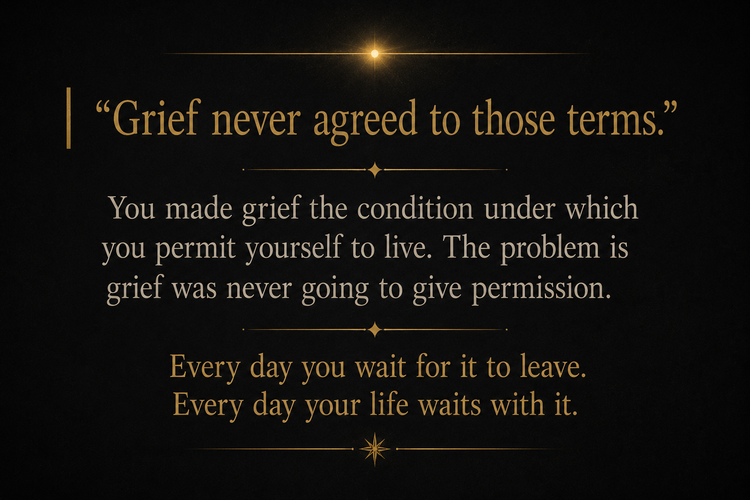
This literary work is a psychological and experiential portrait of a soul losing a world and learning how to stand without it.
It is about growing into one’s true self by relying on direct perception, internal guidance, and personal authority when external structures fail.
The dialogue format mirrors this process, offering readers a way to inhabit the journey rather than consume it. The emphasis remains on resonance over narrative, experience over explanation, and meaning over messenger.
Writing Form
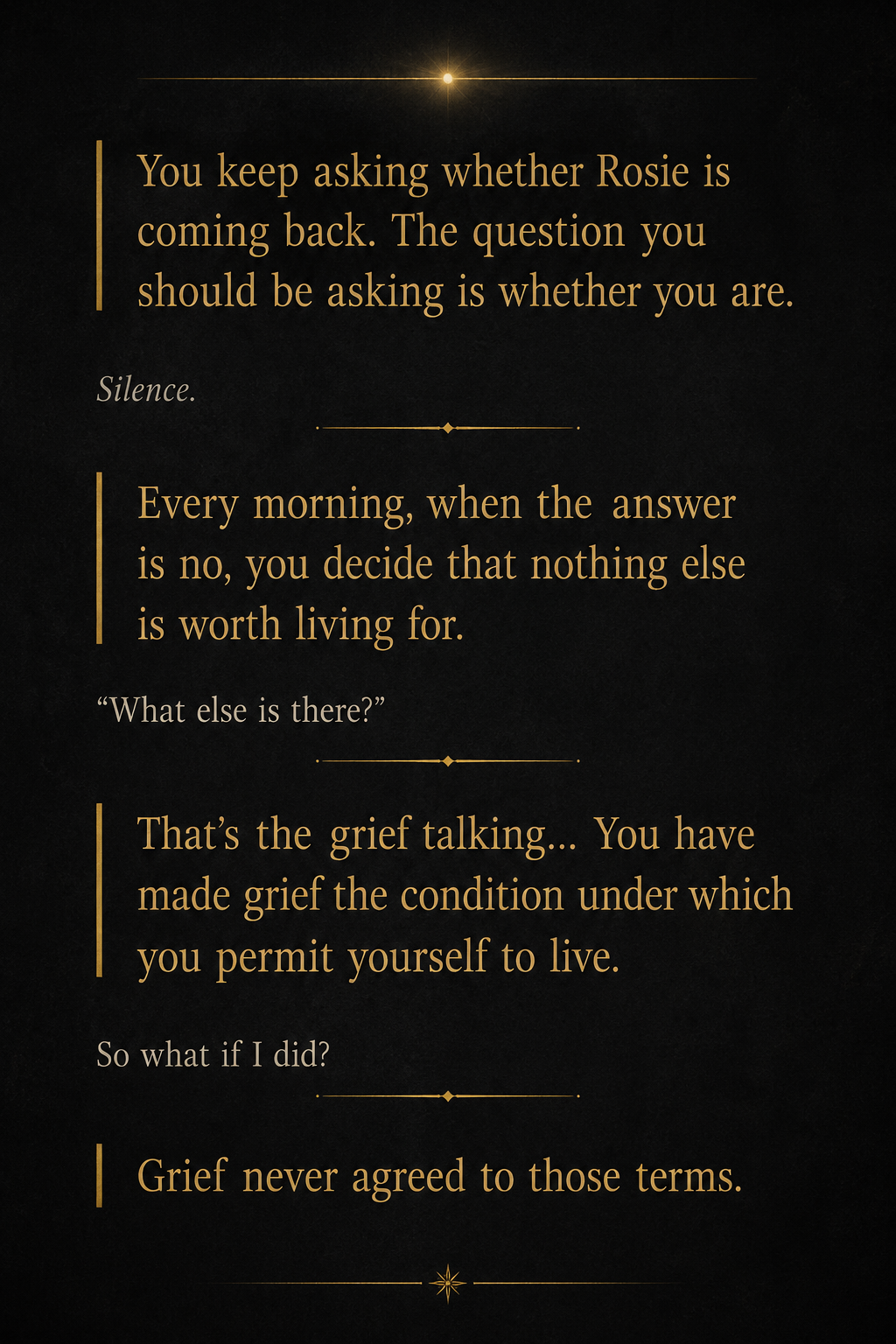
The literature is written in mixed dialogue, often resembling what readers may recognize as Socratic dialoguing, an approach commonly taught in therapeutic training.
Rather than presenting fixed answers, the text moves through questions, exchanges, and reflection, allowing understanding to unfold through inquiry.
Dialogue carries the movement. Reflection answers back.
At times, the dialogue opens into direct truth statements that were clarified and stabilized through later learning and lived integration. Other times, the dialogue is raw and recalled from experiences that occurred in real-time.
This writing form is inspired by the writer’s favorite author, Gary Renard. Some pieces may attempt the iambic pentameter similar to that of Shakespeare or take the stylistic form of the metaphysical teachings from of “A Course in Miracles.” Streams of consciousness allow greater works of writing to enter the space and take a shape of their own. The author does not take credit for the way in which those are written.
Ari, the protagonist in this literature, is positioned as the learner.
Dialogues from the learner, look plain and simple like this.
They arrive without authority or instruction.
They show up as client, patient, student, receiver, observer, reader.
Ari does not lead the dialogue.
Maybe like you, simply enters it.
Sometimes emotes, other times exclaims.
Drops expletives on occasion.
Might even show up grammatically incorrect or in sentences that run on.
Reflecting the humanness of the character.
The main character (Ari)
in both parts is similar to the reader
who might listen, freeze, question, run,
lurk, misunderstand, leave on read,
block then unblock,
Then return and learn.
Ari’s role is not to teach or resolve.
It is to stay present to what is unfolding.
Then to summarize, clarify, integrate the information.
In this way, learning happens through exposure, not performance.
The other strand of the dialogue enters differently.
It appears in bold form.
Visually distinct.
Quieter in tone, yet unmistakably present.
This voice does not argue or persuade.
It does not explain itself.
It arrives with softness that still carries weight,
inviting attention rather than demanding it.
Its authority comes from clarity, not force.
When it appears, the pace slows.
The reader is asked to pause.
To listen rather than analyze.
These moments function less as commentary and more as transmission,
offering something to be received rather than worked through.
Placed alongside the questioning dialogue,
this voice creates balance.
Inquiry opens the field.
The gold and bold presence steadies it.
Together, they allow the text to hold uncertainty while still orienting toward truth letting meaning surface in divine timing
without pressure or instruction.
Similar to the biblical story of the Wise Men who followed the North Star,
— Matthew 2:2 (NRSV)
This soul’s story emphasizes discernment rather than certainty.
Attention rather than authority.
Following a signal that cannot be proven in advance.
In this sense,
NorthStar does not narrate nor explain itself.
It is simply followed.
The Source
The sources of guidance come from a variety of places.
Each voice carrying a distinct kind of its own.
None of which will be identified, though some recognized by the soul.
This keeps the focus on the answer, which remains centered on the message
—not the messenger.
The guidance of learning derives from both outer and inner worlds.
Outer forms of support may include:
Professional
- therapists, lawyers, teachers, business owners, pastors/imams and other religious/ spiritual leaders, medical health providers, politicians and related public figures, reiki healers, illusionists, intuitive spiritual advisors or “gurus,” tarot /psychic readers, motivational speakers, performance endurance artists, etc
Personal
- individual experiences of cause (learning derived from outer experience of living, travel, space and time, books, business, law, music, movies, science, justice, art).
- individual experiences of effect: (learning expressed through creative outlets blogging, vlogging, storywriting, songwriting, music production, business creation and optimization, self-care practices, etc)
Social
- the awakened soul collective (often referred to as ‘soul tribe’)
- friends, family, neighbors, colleagues, acquaintances, strangers,
- animals and nature (esp bodies of water, plants/flowers, grass, and trees!)
Inner
Inner Guide/Higher Self
insights through meditation, prayer, writing, reiki, exercise, etc
often referred to as “God” or “Higher Power” or “the Universe”
In therapy, IFS-informed psychologists/therapists refer to this as ‘Self-Energy’
Combination of Intuition and Intellect
Deep shadow work, self-analysis, self-reflection, and integration.
Timing
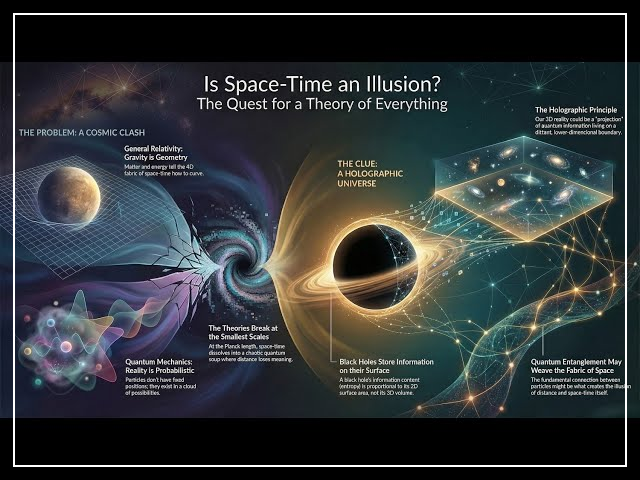
Time is treated as holographic.
Linear sequence is not required for understanding.
Entries may appear out of order.
Some begin near resolution.
Some arrive mid-process.
Others return to an earlier point.
Each piece stands on its own while also belonging to a larger field of inquiry.
The order is less important than the resonance.
Meaning assembles through contact, not chronology.
The timing of each stack is less about sequence and more about posture.
It invites curiosity.
It practices patience.
It asks for a willingness to sit with ambiguity,
much like the character in this story did.
There is no rush to move through each season.
No pressure to resolve meaning too quickly.
The work resists jumping to conclusions,
allowing understanding to arrive at its own pace.
With no external authority left to lean on, Ari begins to notice something that had always been muted beneath expectation and attachment: an internal signal. At first it is faint and unreliable. Over time, as everything else falls away, it becomes clearer and more precise. Trust in intuition does not arrive as confidence or enlightenment. It arrives as necessity.
The series traces Ari’s gradual shift from dependence to self-reference, from borrowed meaning to lived discernment, while acknowledging the forms of support that appear along the way—sometimes human, sometimes symbolic, sometimes difficult to explain.
Stranger Things
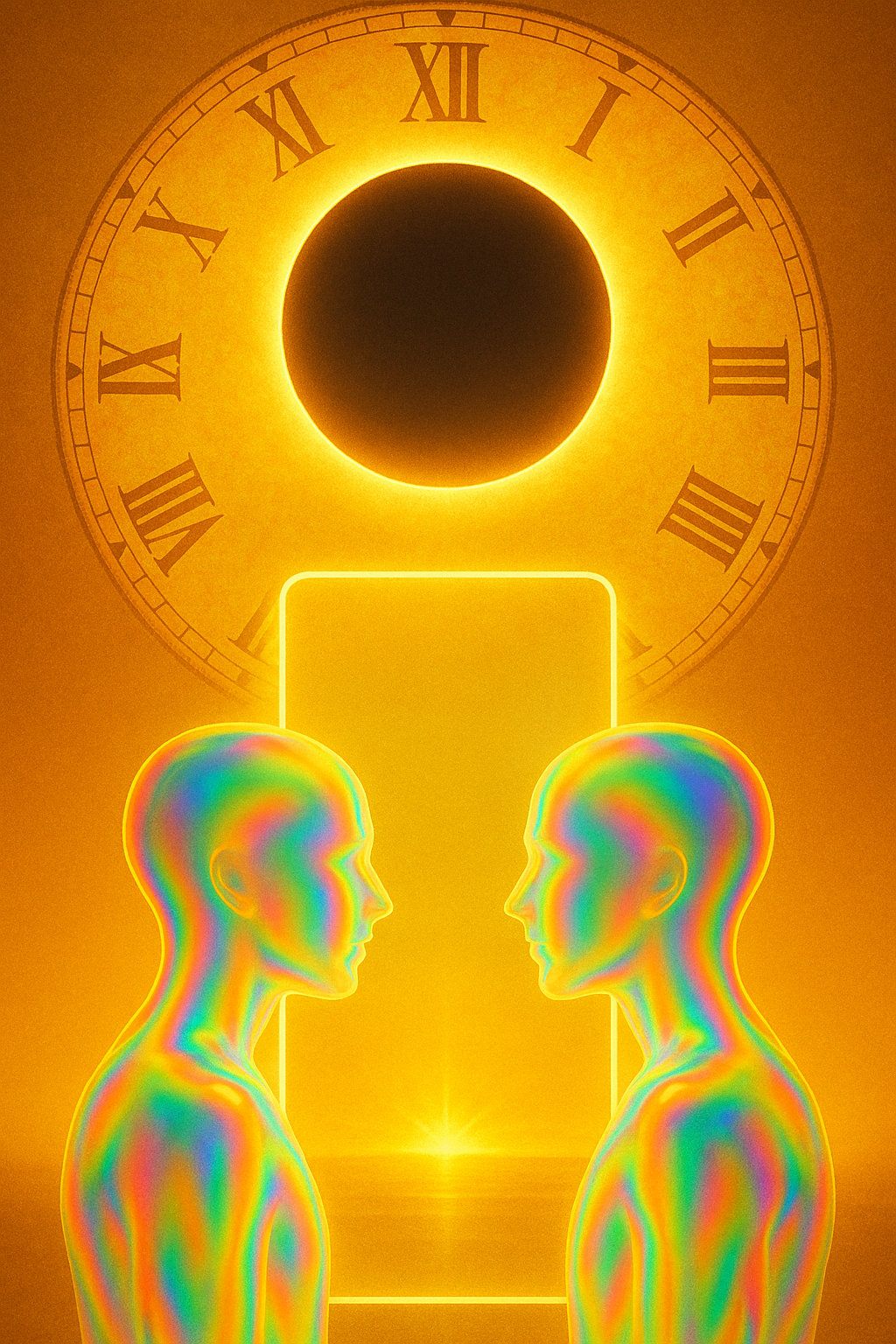
A subtle sci-fi and mystical thread runs through the narrative, where quantum physics meets metaphysics and wounded masculine and feminine energies mature into something more integrated and mature, maybe even Divine.
Some moments are drawn directly from lived experience, while others move into speculative or symbolic territory, allowing ideas such as “Twin Flames” and “Twin Rays” to be explored alongside questions of truth and justice within both the Matrix and a broader, collective field of consciousness in the midst of awakening. Time is treated as holographic, and reality is not confined to the third dimension. Fact and fiction are intentionally intertwined, with the boundary between them left unresolved.
Discerning between what is ‘real’ versus what is not becomes secondary, as the focus remains on the meaning of the message being transmitted rather than the literal source of any singular interaction or event.
Why subscribe?
Subscribe to get full access to the newsletter and publication archives.
Stay up-to-date
Never miss an update—every new post is sent directly to your email inbox. For a spam-free, ad-free reading experience, plus audio and community features, get the Substack app.
Join the crew
Be part of a community of people who share your interests. Participate in the comments section, or support this work with a subscription.
To learn more about the tech platform that powers this publication, visit Substack.com.